In the book, Taming the Tiger Within: Meditations on Transforming Difficult Emotions, Master Thick Nhat Hanh wrote: ” One of the main causes of our suffering is the seed of anger inside of us. Anger always goes together with confusion, with ignorance. Anger is born from ignorance and wrong perceptions. You may be the victim of a wrong perception. You may have misunderstood what you heard and what you saw. You may have a wrong idea of what has been said, what has been done. Every one of us must practice looking deeply into our perceptions, whether we are a father, mother, child, partner or friend.
The Buddha never advised us to suppress our anger. He taught us to go back to ourselves and take good care of it. Anger, despair, or jealousy are like a howling baby, suffering and crying. Nothing is more urgent than taking good care of your baby. Practice looking deeply into the nature of your anger. The practice has two phases. The first is embracing and recognizing: “My dear anger, I know you are there, I am taking good care of you.” The second phase is to look deeply into the nature of your anger to see how it has come about.
Just embracing your anger, jut breathing in and breathing out, that is good enough. The baby will feel relief right away as you embrace it with the energy of mindfulness. Mindfulness means to be present, to be aware of what is going on. You have too cook your anger on the fire of mindfulness, and it may take ten minutes, or twenty minutes, or longer. In our consciousness, there are many negative seeds and also many positive seeds. The practice is to avoid watering the negative seeds, and to identify and water the positive seeds every day. Every time you feel lost, alienated, or cut off from life, or from the world, every time you feel despair, anger, or instability, practice going home. Mindful breathing is the vehicle that you use to go back to your true home.”
Mindfulness rooted in the mechanism of Heaven Earth Human as one wholesome ecosystem, which is also in line with the cosmology view of Taoism. Master Thich Nhat Hanh call on an environmental stewardship that contributes to a much-needed transition from ecological alienation to ecological alignment. “Ecological alienation” refers to the fundamental disconnect between state, corporate, and consumer behavior on the one hand, and directly and indirectly related negative environmental consequences on the other. His term “ecological alignment” refers to a certain affection for and attachment to the natural world, which involves participation in both nature-based and culture-based collective efforts toward the mutual flourishing of ecosystems, communities, and ourselves. We and the Earth are one is Master Thich Nanh’s statement on climate change in United Nations.
Here we are using the life long struggle of Danie Quinn to validation of what Master Thich Nhat Hanh teaches above. Daniel Quinn was an American author, cultural critic, and publisher of educational texts. Providence: The Story of a Fifty-Year Vision Quest is Quinn’s fascinating memoir of his life-long spiritual voyage. His journey takes him from a childhood dream in Omaha setting him on a search for fulfillment, to his time as a postulant in the Trappist order under the guidance of eminent theologian Thomas Merton. Quinn also details his rejection of organized religion and his personal rediscovery of what he says is humankind’s first and only universal religion, the theology that forms the basis for Ishmael, which won the $500,000 Turner Tomorrow Fellowship Award in 1991. Providence address issues of education, psychology, religion, science, marriage, and self-understanding, and will give insight to anyone who has ever struggled to forge and enact a personal spirituality.
The philosophical novel Ishmael explores the relationship between an ageing guerilla and a man seeking to change the world. Through a form of nonverbal communication, they discussed God, man, the relationship between humans and animals, and how both relate to the destruction of the natural world. Ishmael is this half ton silverback gorilla. He is a student of ecology, life, freedom, and the human condition. He is also a teacher. He teaches that which all humans need to learn – must learn – if our species, and the rest of life on Earth as we know it, is to survive.
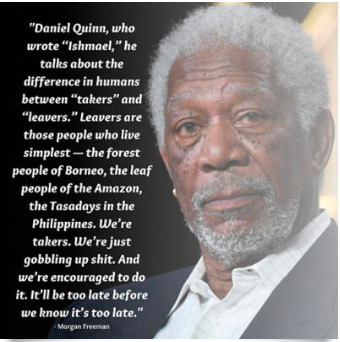
Quinn’s ideas are popularly associated with environmentalism, though he criticized this term for portraying the environment as separate from human life, thus creating a false dichotomy, and the environmental movement as misguided and ultimately ineffective. The mindset is source of the issue: “There’s nothing fundamentally wrong with people. Given a story to enact that puts them in accord with the world, they will live in accord with the world. But given a story to enact that puts them at odds with the world, as yours does, they will live at odds with the world. Given a story to enact in which they are the lords of the world, they will act like lords of the world. And, given a story to enact in which the world is a foe to be conquered, they will conquer it like a foe, and one day, inevitably, their foe will like bleeding to death at their feet, as the world is now.”
So the story we tell ourselves is the mental formation. In the globalized world, hyper-individuality and reliance on abstract brain processes have become the model of being manifested in the crisis of many arenas: Politics without principle; wealth without work; pleasure without conscience; knowledge without character and compassion; commerce and industry without morality; science without humanity; and worship without sacrifice; the damage that was being done to the Earth through human misuse of technology; the penetration into food-chains of poisonous substances and the mounting exploitation of natural resources.
Meanwhile, our relationship with our bodies is interrelated with our minds, and our relationality with each other and Mother Earth is continuously dismissed and undermined. To flourish and recover our embodied homes requires healing from this alienation. it requires counteractions of connection and belonging. The Human Body and Ideology: Concepts of the Ancient Nahuas, an extraordinarily ambitious work, encyclopedic in scope, that showcases author López Austin’s impressive command of both the ethno-historical sources on Central Mexico and the broader ethnographic literature on Mesoamerica. The book shows how ideas about the physiological and animistic characteristics of body parts were integral to a broader Nahua ideology and world view, and how this ideology, in turn, structured and legitimated the social hierarchy. In chapters on Nahua ideas about the origins of life on earth; about age, gender, and sexuality; about death; and about the body and the spirit world, scholars in a variety of disciplines will all find something to fascinate them.
The monumental challenges of our world often lead us to disconnect and focus on our mental health. This focus on our own state of mind alone is why many struggle to flourish. What’s been overlooked is the Indigenous perspective of relationality. Happiness is only possible in community, when we cultivate our relationships toward all kin in our living Earth. The Earth is a living organism. The ancient Greeks gave her the powerful name Gaia and looked on her as a goddess. Before the nineteenth century even scientists were comfortable with the notion of a living Earth. This wholesome view of our planet did not persist into the next century. Science was developing rapidly and soon fragmented into a collection of nearly independent professions. It became the province of the expert, and there was little good to be said about interdisciplinary thinking.
In the Central America Indigenous Nahua body healing system, the senses are seats of consciousness that hold the power of decision-making, will, and creative force, and thus of temperance, attention, and flow. When observed, embraced, and allowed to flow intentionally, the subtle energies moving through the body many encourage balance, well-being, and flourishing. However, when exacerbated, these energies may lead to confusion, reactivity, and devastation. Nahua communities use various practices of observation, regulation, and channeling of these energies.
An eminent quality of these systems is that afflictions are systemic. As we often see within Indigenous lifeways, humans are never separated from nature. Humans belong to the whole and so we influence, stimulate, and are shaped b the environment. in the same way, animic entities are never solely human. they many manifest in the body, heart, and mind, but they are informed by disturbances in the environment where the flow of Spirit has been hindered.
The animic entities are thought to traverse the world in multiple realms. These dimensions vary only in degree of sutlety. They can leave the body and inhabit other bodies temporarily. Therefore, one way to restore the natural flow, health, and flourishing in the ecosystem is to tend to these entities. By embracing them fully, we do not resist but instead open to new rides for the flow of essences to run in a beneficial sway.