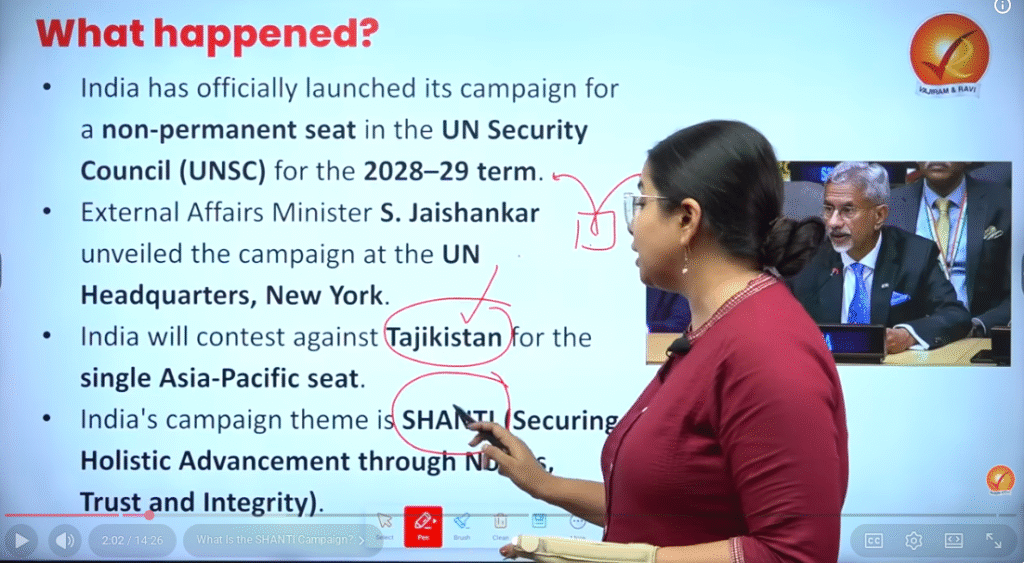
India has been staked its bid at the UN General Assembly for permanent members, and support is coming in from the G4, BRICS and four European countries for at least last six years. with a population the biggest in the world, its computer engineers becoming the dominant source of support in the high tech companies of United States and Canada as well as Europe, its GDP one of the leading tops, and its strong capability in nuclear management and rocket science for outer space, its leading organic medicine industries… etc etc. India is one of the strongest leaders for the global south. It is certainly warrant its bids.
However, there seem to be something wrong with India’s self management. India’s education system produce only computer coders, alas lacking true leadership for innovations and systematic changes. India’s computer talents had been a dominant forces in major technology companies. But I heard that these high pay jobs does not generate tax incomes for the countries they worked for, instead, a lot of these tax savings of these high earners have been sent back to India to support Indian economy.
So there comes the questions, with so much international support, how did the Indian government effectively use these resources? For decades, local infrastructure and public utilities has been a dragging leg of India’s development, blocking its further progress. The high inequality speaks of the weakness of India government in manage of its county, or shall we say its philosophy of self governance is still following a mentality as colonia people, or maybe even worse incompetence of self governance. The high raping statistics of India …. As a close observer and admirer of Buddha’s hometown, a birth country of many saints and yogis, I had been wanted to visit India ten years ago, but was informed of its chaotic security management and public facilities. I remember a few years ago, many countries, including China, and Japan had invested heavily to help India’s public facilities, alas, they all stalled by the bureaucracy of India government and its severe corruptions.
So I assume the world at large would share my sentiments: will a country that are not able to manage its local security and public infrastructure, be able to function well as a UNSC member in the General Assembly? What should India do to boost its trustworthiness to the world? What kind of attitude should India demonstrate to the world at large that its political system and process has true capacities to service its people and do the work for the common goods, rather than support just a few capitalists? How can India government boost its market attractiveness and win-win potentials for investors from foreign countries?
People can not help compare India with China. What did China do well that India is not capable of ? I asked AI this question, and the answer is:
This essay argues that China’s success and India’s lag are best explained by differences in national cohesion –China’s success was built on a unified language, standardized systems, a meritocratic tradition, and a radically egalitarian social structure.
I do not agree that China is “a meritocratic tradition, and a radically egalitarian social structure.” China had done tremendous damages and cause gigantic pollutions to its land for the purpose of GDP growth. I do not feel China is a successful model for India. Neither do I think China has a egalitarian social structure. Justi the most recent World Bank data show China’s Gini index at 36.0 in 2022, – the number is much lower than what I feel from the complaints and social problems reflected in current China. China’s reform had come with gigantic side effects and costly destructions to its social harmony – which I truly wish India will not fall into the same trap.